-
A pedestrian using a white cane or a guide dog is waiting to cross. What should you do?
Correct answer: Stop and let the person cross; they have the right-of-way
A white cane or guide dog means the person is blind or has low vision. Always yield to them.
-
What does this sign mean?
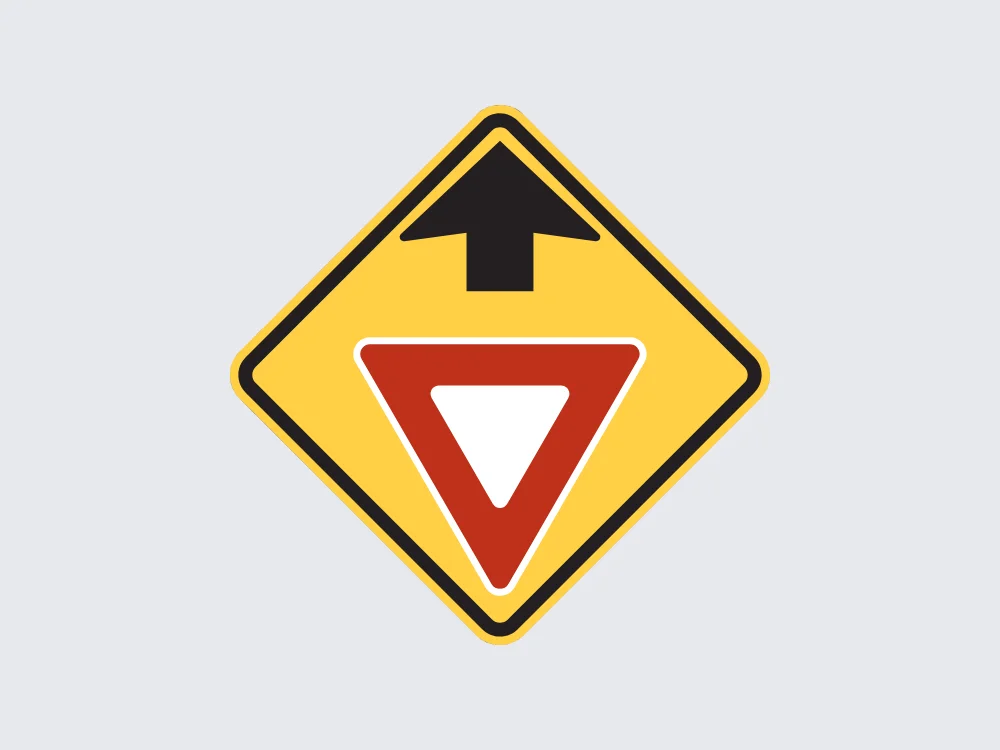
Correct answer: A YIELD sign is ahead; slow down and be ready to yield
It warns of a YIELD sign ahead, so be ready to slow down or stop to let other traffic go first.
-
You are on a two-lane road approaching the top of a hill and cannot see what is coming. A slow truck is ahead. What should you do?
Correct answer: Stay behind it until you can see far enough ahead to pass safely
Do not pass near a hilltop or curve where you cannot see oncoming traffic. A head-on crash is the likely result if something appears.
-
An animal suddenly runs in front of your car and you cannot avoid it safely. What should you do?
Correct answer: Brake firmly and stay in your lane rather than swerving into traffic or off the road
Swerving into oncoming traffic or off the road often causes a worse crash than hitting the animal. Keep the car under control.
-
A 16-year-old is convicted for the first time of texting while driving. What is the license suspension?
Correct answer: 30 days
A teen's first phone or texting conviction brings a 30-day suspension, then 90 days and 6 months for repeat offenses.
Connecticut Driver's Manual, p. 36 -
A white diamond is painted in a lane. What does it tell you?
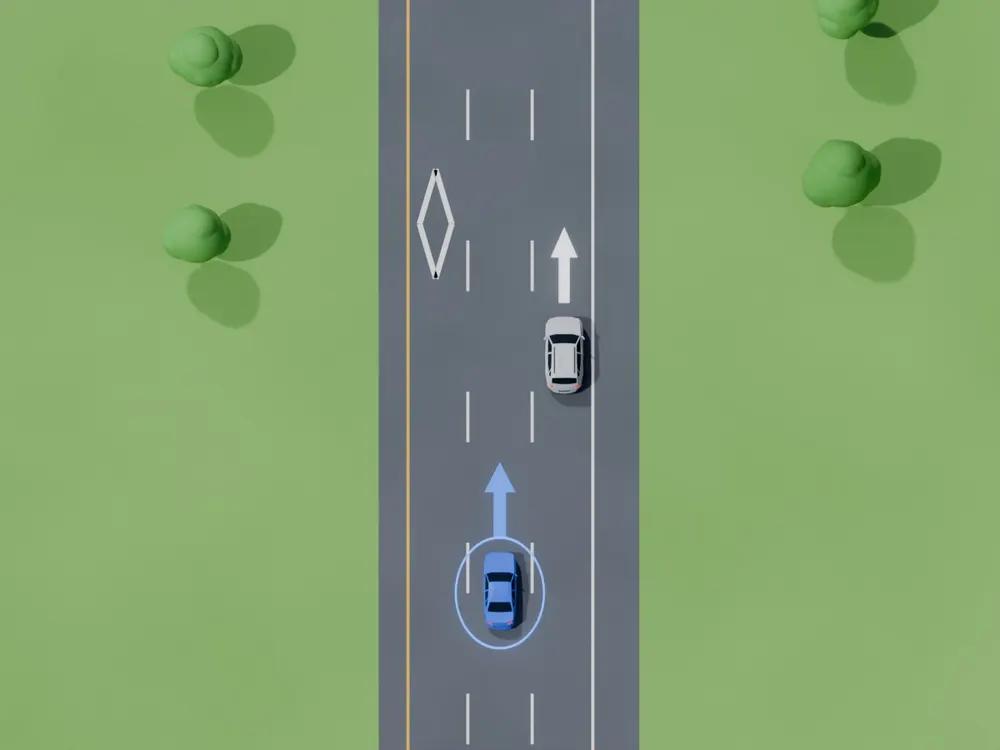
Correct answer: The lane is reserved, for example for carpools or buses
The diamond symbol marks a restricted lane, such as HOV or bus-only. Use it only if you meet the posted rules.
-
At a T intersection with no signs, you are on the road that ends. Who has the right-of-way?
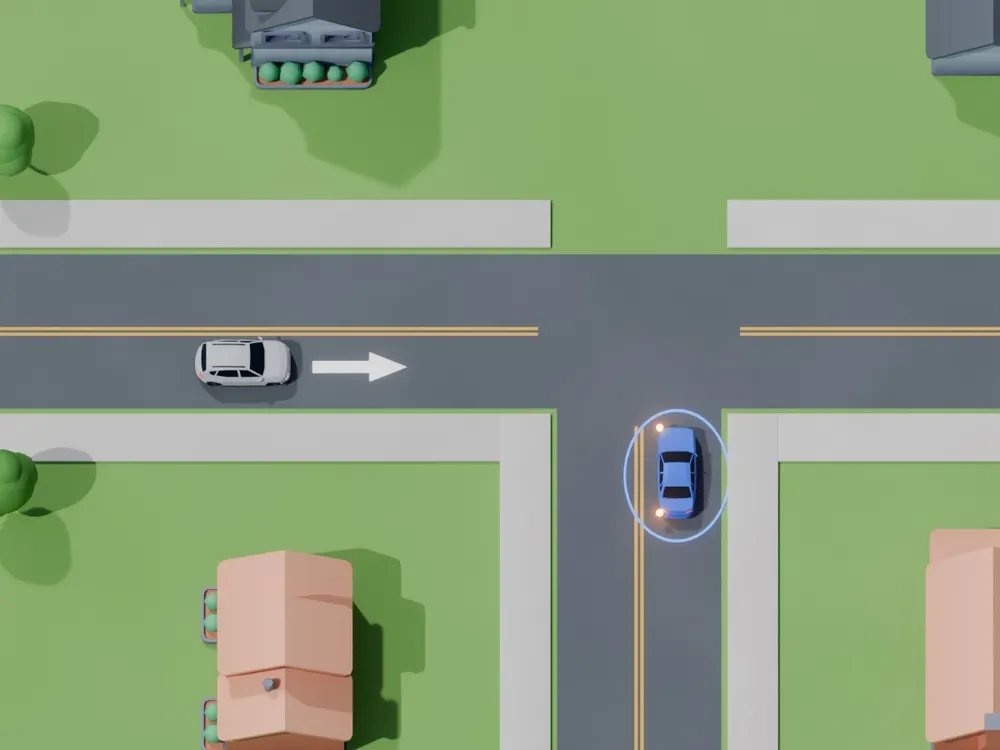
Correct answer: Traffic on the through road
At a T intersection without signs, vehicles on the road that continues straight go first. The driver on the ending road waits.
-
You are merging onto a freeway from an on-ramp. Who has the right-of-way?
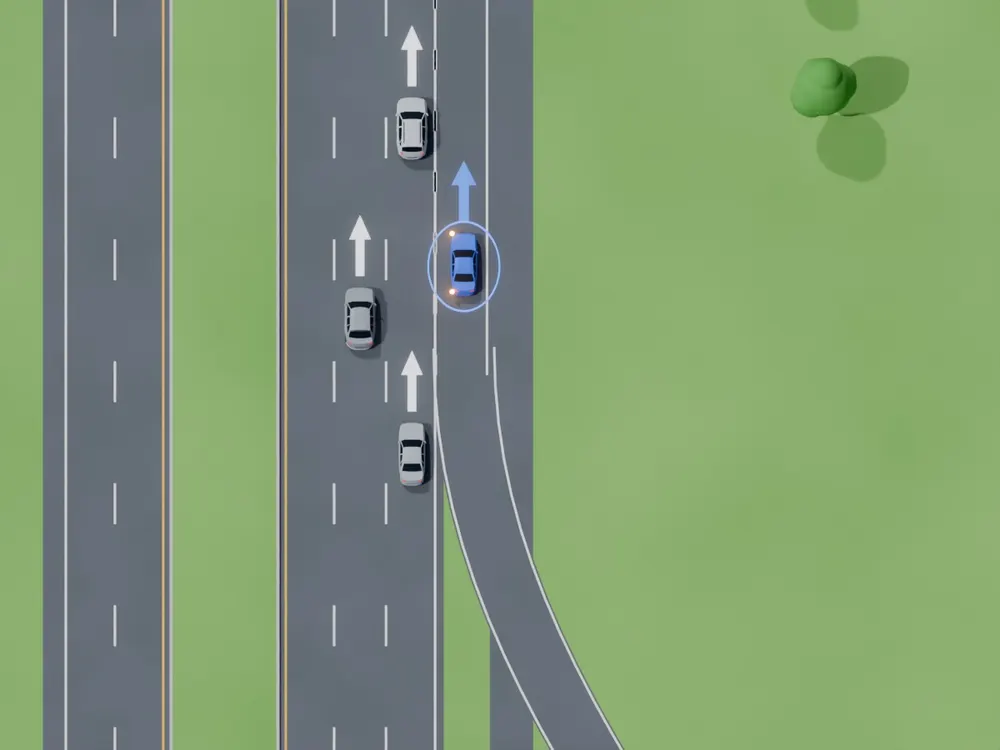
Correct answer: Traffic already on the freeway
Drivers entering a freeway must yield to vehicles already on it and fit into a safe gap.
-
The road is wet from rain. By about how much does the Connecticut manual tell you to lower your speed?
Correct answer: About 10 mph
On wet pavement the tires grip less, so the manual advises dropping your speed by roughly 10 mph; packed snow calls for cutting it in half.
Connecticut Driver's Manual, p. 27 -
You feel dizzy, sleepy and get a headache while driving with the windows closed. What could be the cause?
Correct answer: Carbon monoxide from a leaking exhaust
Carbon monoxide has no smell and can kill. Get fresh air, have the exhaust checked, and never run the engine in a closed garage.
-
On a two-lane road, within what distance of a hill or curve should you not start to pass?
Correct answer: Within a third of a mile
You need about a third of a mile of clear view to pass, so treat a hill or curve inside that distance like an oncoming car.
Connecticut Driver's Manual, p. 26 -
Signs that warn of road construction and maintenance work are usually what color?
Correct answer: Orange with black letters or symbols
Orange is reserved for work zones. When you see orange signs, cones or drums, expect workers, equipment and changed lanes.
-
Is it legal to park in front of someone's driveway for a short time?
Correct answer: No, blocking a driveway is not allowed
Parking in front of a public or private driveway blocks people from getting in or out and is prohibited.
-
The pedestrian signal is flashing a raised hand, and a person is still in the crosswalk. As a driver you should:
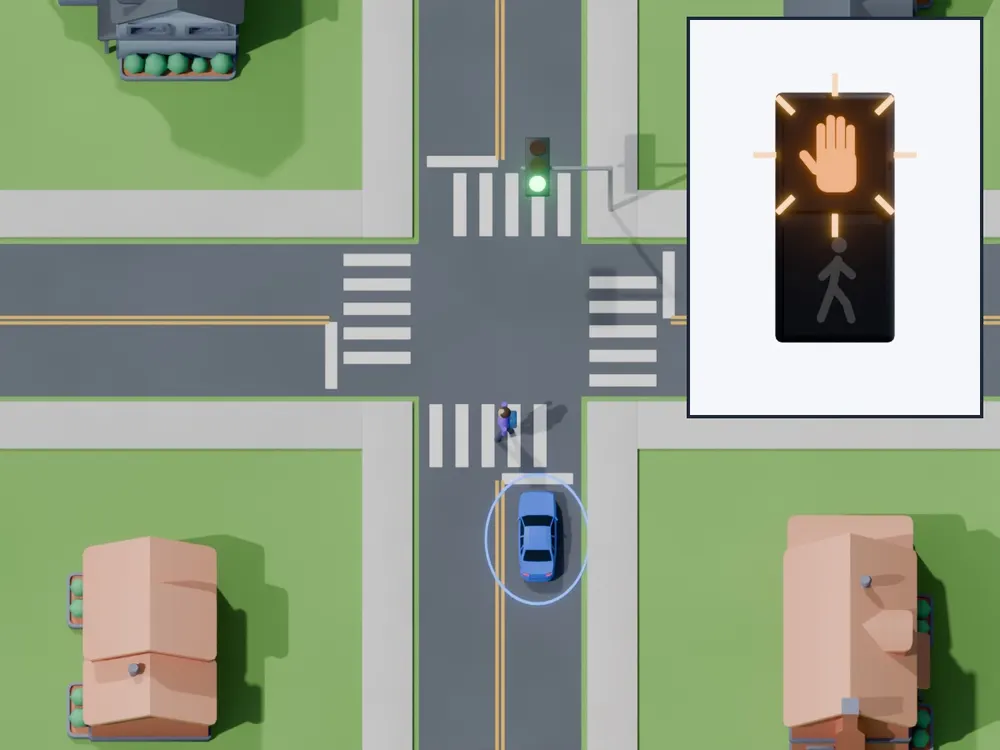
Correct answer: Yield and let the person finish crossing
A flashing hand tells pedestrians not to start crossing, but anyone already crossing may finish. Drivers must still yield to them.
-
A child is 18 months old but already weighs 32 pounds. Which seat rule applies?
Correct answer: A rear-facing seat, because of the age
When age and weight point to different categories, the more restrictive requirement wins. A child under 2 still rides rear-facing.
Connecticut Driver's Manual, p. 14 -
When should you increase your following distance beyond your normal gap?
Correct answer: On wet or slippery roads and in bad weather
It takes longer to stop when traction is poor or visibility is low, so you need more room.
-
Your right wheels drift off the pavement onto a soft shoulder. What should you do?
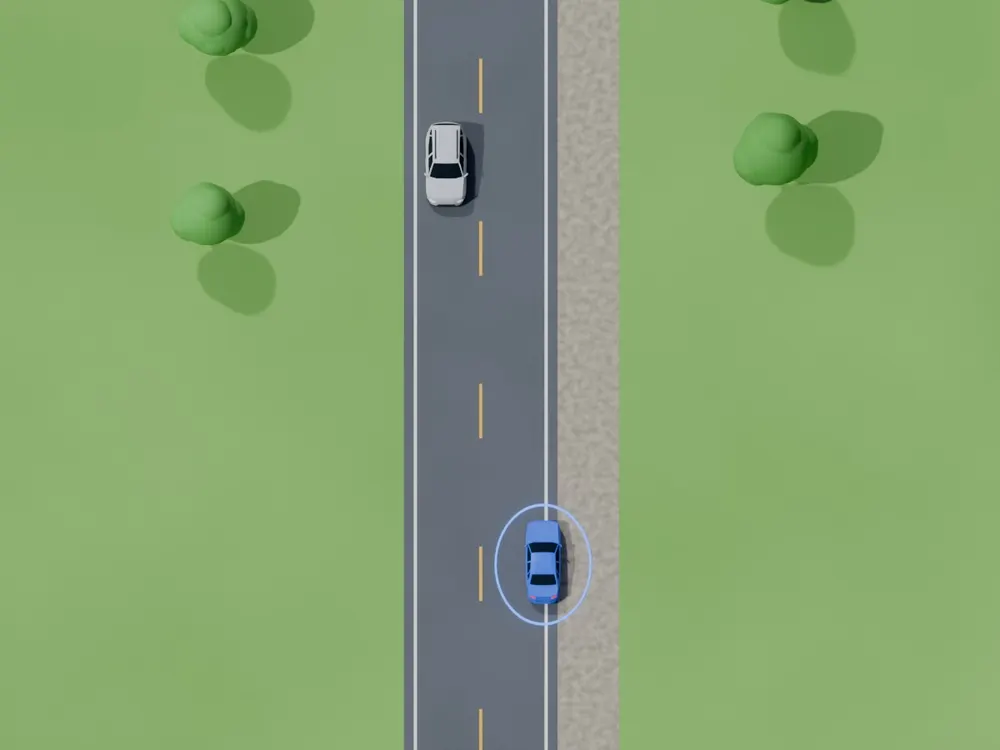
Correct answer: Grip the wheel, ease off the gas, brake gently, and steer back once you have slowed and checked traffic
A sharp turn back at speed can send you across the road into oncoming traffic. Slow down first, then return smoothly.
-
Which call may a driver of any age make on a hand-held phone while driving in Connecticut?
Correct answer: Calling the police to report an emergency
In an emergency anyone may contact an emergency operator, a hospital, a doctor's office, a clinic, an ambulance company, or the police or fire department.
Connecticut Driver's Manual, p. 15 -
How close to a STOP sign may you park in Connecticut?
Correct answer: No closer than 25 feet
Keep a parked car at least 25 feet away from a stop sign; a pedestrian safety zone needs the same gap.
Connecticut Driver's Manual, p. 39 -
During which hours may a 16- or 17-year-old licensed driver not drive, unless an exception applies?
Correct answer: 11 p.m. to 5 a.m.
The curfew runs from 11 p.m. to 5 a.m. Driving for a job, school, religious activities, a medical need or the Safe Ride Program is allowed.
Connecticut Driver's Manual, p. 10 -
Which way does traffic flow around a roundabout?
Correct answer: Counterclockwise
In the United States, traffic in roundabouts and rotaries always travels counterclockwise around the center island.
-
It starts to rain in the afternoon and you switch on your windshield wipers. What else does Connecticut law require?
Correct answer: Turning on your headlights
Whenever the wipers are on, Connecticut requires headlights too, so others can see your vehicle in the rain.
Connecticut Driver's Manual, p. 40 -
Which sign is the only one with an eight-sided (octagon) shape?
Correct answer: STOP
The octagon is reserved for STOP signs, so drivers can recognize them by shape alone, even from behind or in snow.
-
Under Connecticut's zero-tolerance law for drivers under 21, what blood alcohol level brings penalties?
Correct answer: 0.02 or more
For drivers under 21 any measurable alcohol counts, and the law sets that line at 0.02 percent.
Connecticut Driver's Manual, p. 35 -
A 16-year-old completed driver education at a commercial driving school. How long after the permit is issued may the road test be taken?
Correct answer: 120 days
Teens trained by a commercial or high school program wait 120 days; all other teen applicants, including home-trained ones, wait 180 days.
Connecticut Driver's Manual, p. 8
Your result
Finish the test to see your score. You need 20 of 25 correct.
Review your mistakes
About the Connecticut DMV written test
Facts from the Connecticut Department of Motor Vehicles, with links to the official pages.
- Questions
- 25 questions source ↗
- To pass
- 20 correct answers out of 25 source ↗
- Time limit
- No published time limit
- Permit age
- 16 years source ↗
- Fee
- $40 license exam fee; $19 learner's permit source ↗
- If you fail
- Wait 7 days and pay $40 again
- Test in Spanish
- Yes, the knowledge test is offered in Spanish source ↗
- Online test
- No; by appointment at select DMV offices source ↗
Our practice test: 25 questions, 20 correct to pass.
Official sources
What the Connecticut test covers
Topics in our 430 Connecticut practice questions, written from the Connecticut Driver's Manual. 57 of them cover rules specific to Connecticut.
- Intersections and turns36
- Regulatory signs33
- Sharing the road31
- Weather and night driving28
- Right of way27
- Traffic signals26
- Pavement markings26
- Lanes and passing24
- Parking20
- Warning signs20
Connecticut numbers to know
The figures test writers love, from the Driver’s Manual, State of Connecticut Department of Motor Vehicles. Open the handbook ↗
Speed limits
| Wet road | Slow down about 10 mph |
| Packed snow | Cut speed in half |
| Stopping distance at 30 / 50 mph | About 200 / 400 ft |
Alcohol
| Under 21 (zero tolerance) | From 0.02 BAC |
| Failed BAC test | 45+ days, then interlock 6+ months |
| Refusing the test (any age) | 45+ days, then interlock 1+ year |
Permit and teen drivers
| Permit trainer | 20+, licensed 4 years in a row |
| Wait before road test (under 18) | 120 days with school, else 180 |
| Curfew (16–17) | 11 p.m. – 5 a.m. |
| First 6 months: passengers | Instructor, parents or one adult 20+ |
Phones
| Adults | Hands-free only, even when stopped in traffic |
| Under 18 | No device at all, except emergencies |
| Phone fine in a work zone | Doubled |
Seat belts and child seats
| No seat belt | $75 each, driver and passengers |
| Under 2 or under 30 lb | Rear-facing, 5-point harness |
| Age 5–8 or 40–60 lb | 5-point harness or booster |
School buses
| School bus with red lights | Stop on either side |
Points and penalties
| Work zone violations | Fine up to $1,000 |
| Operator Retraining Program | 24 and under: 2 violations; 25+: 3 |
| Teen 20 mph over the limit (1st) | 60-day suspension |
Distances
| Passing a bicyclist | At least 3 ft |
| Behind a truck | At least 3 seconds |
| Ice cream truck with stop arm | Stop 10+ ft away, pass at 5 mph |
| No parking near a STOP sign | 25 ft |
| No parking near a fire hydrant | 10 ft |
Questions and answers
How many questions are on the Connecticut permit test?
25 questions. To pass: 20 correct answers out of 25.
How many questions can you miss on the Connecticut permit test?
You can miss up to 5 of 25 questions: you need 20 correct answers.
Can you take the Connecticut permit test in Spanish?
Yes, the knowledge test is offered in Spanish.
Can you take the Connecticut permit test online?
No; by appointment at select DMV offices.
What age can you get your permit in Connecticut?
You can apply for a learner's permit at 16 years.
How long is the Connecticut permit test?
No published time limit.
What happens if you fail the Connecticut permit test?
Wait 7 days and pay $40 again.
How much does the Connecticut permit test cost?
$40 license exam fee; $19 learner's permit.
How do I study for the Connecticut permit test?
Read the Connecticut Driver's Manual, then take practice tests in the real exam format until you pass them with room to spare. Learn the numbers by heart: speed limits, following distances, alcohol limits and permit rules. The dmvly app has 430 Connecticut questions with an explanation for each one.