-
To qualify for a Kansas farm permit, a teen must live or work on a farm of at least what size?
Correct answer: 20 acres
A farm permit is for teens aged 14 to 16 who live on, or are paid to work on, a farm of 20 acres or more used for agriculture.
Kansas Driving Handbook, p. 11 -
When is passing another vehicle on the right allowed?
Correct answer: When the vehicle ahead is turning left and there is room to pass safely
Passing on the right is allowed only in certain cases, such as when the driver ahead is turning left and the road leaves room to do it safely.
-
After a long stretch of freeway driving, you take an exit. Why should you check your speedometer?
Correct answer: You may be going faster than you feel, and the ramp speed is lower
After high speeds, a slower pace can feel too slow. Check the speedometer and slow to the posted ramp speed.
-
You are turning right at an intersection. Who must you watch for and yield to?
Correct answer: Pedestrians crossing the street you are turning into
Right turns cross the path of people in the crosswalk. Always check for pedestrians, and also for bicycles and motorcycles beside you.
-
A Kansas driver refuses a chemical test for alcohol for the first time. What is the mandatory suspension?
Correct answer: 1 year
Under implied consent, refusing the test the first time costs the license for one year, and each later refusal brings a longer suspension.
Kansas Driving Handbook, p. 14 -
A 15-year-old with a Kansas restricted license wants to drive alone to an evening school football game. Is this allowed?
Correct answer: No; only direct trips to attend classes count
At 15, a restricted license allows direct trips between home and school to attend on school days, but not school activities; work, farm work and religious activities are also allowed.
Kansas Driving Handbook, p. 13 -
What does this sign mean?
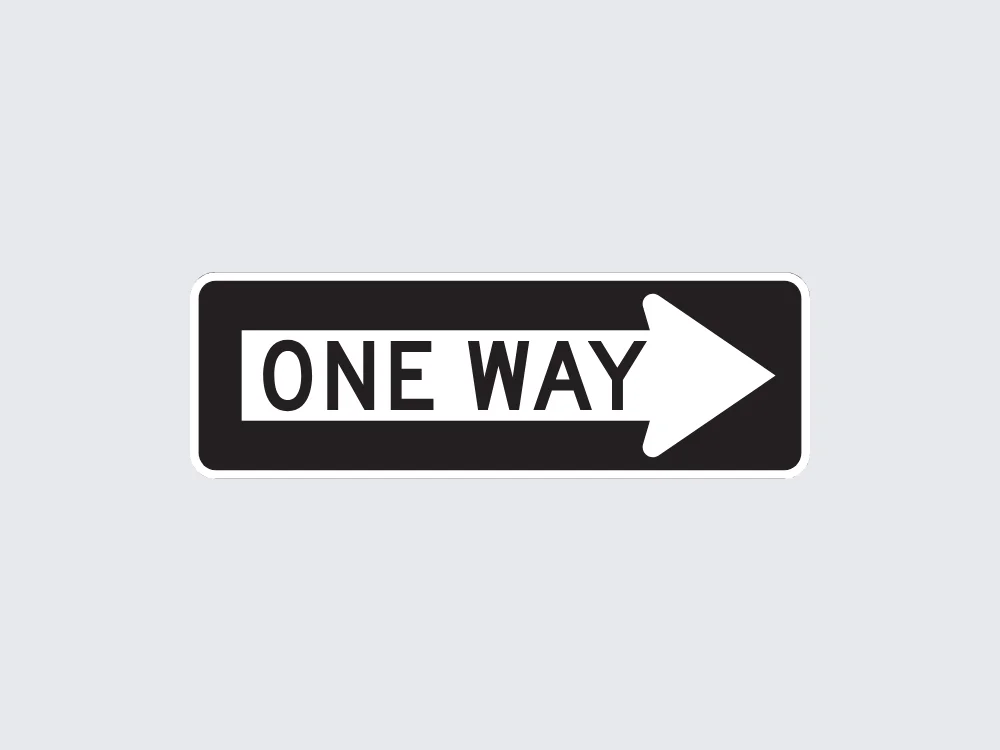
Correct answer: All traffic on this street moves only in the direction of the arrow
ONE WAY signs show the only direction traffic may travel on that street.
-
No speed limit is posted in a work zone you are entering. How fast should you drive?
Correct answer: Slower than normal, and slow enough to react to workers and equipment
Even without a posted work zone limit, conditions in a work zone call for a reduced speed.
-
You want to turn left on a solid green light (no arrow). An oncoming car is close. What should you do?
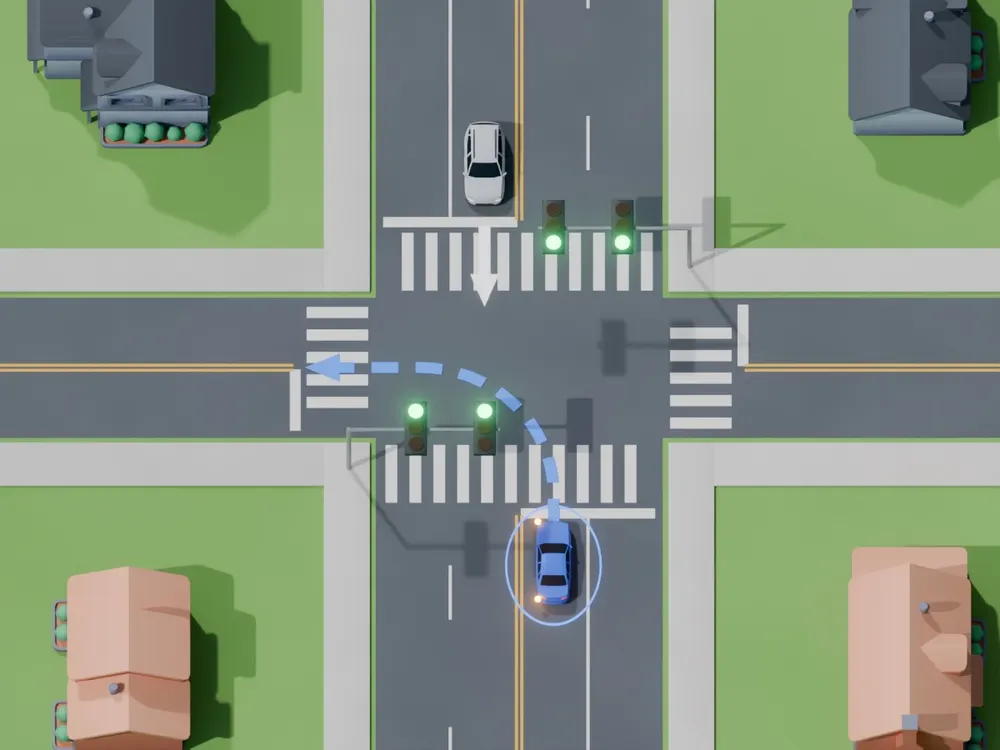
Correct answer: Yield and wait for a safe gap before turning
A green circle allows the left turn, but oncoming traffic close enough to be a danger goes first.
-
You park on a hill where there is no curb. Which way should you turn your front wheels, uphill or downhill?
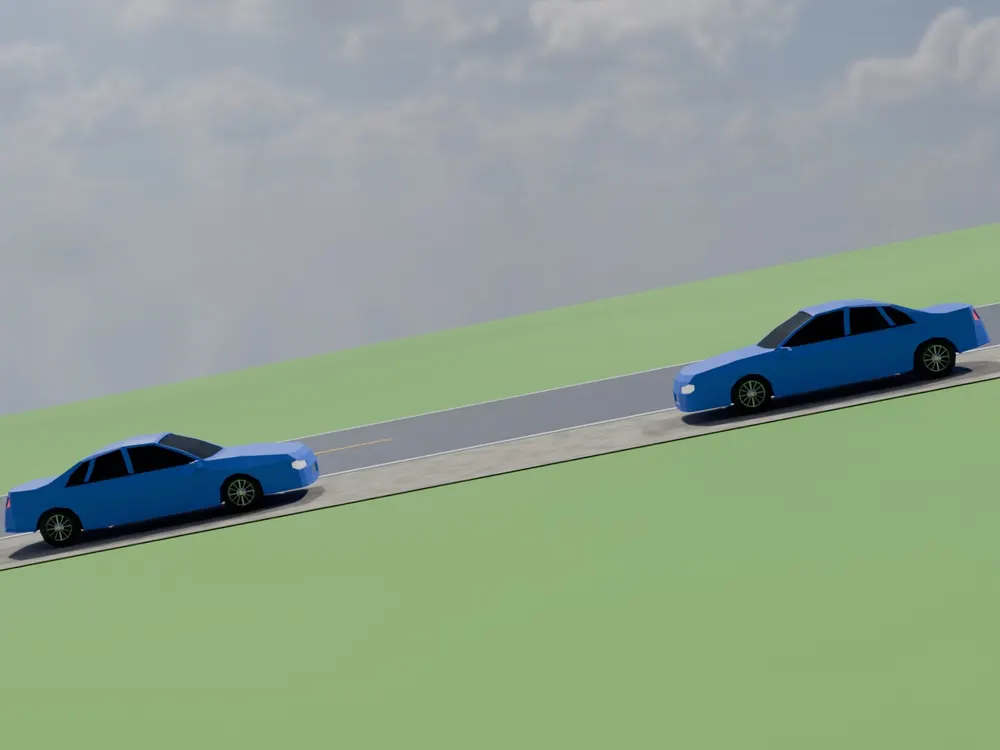
Correct answer: Toward the edge of the road, so the car would roll away from traffic
Without a curb, turn the wheels toward the shoulder in both directions. If the brakes fail, the car rolls off the road instead of into traffic.
-
Your car has antilock brakes (ABS). How should you brake in an emergency stop?
Correct answer: Press firmly and keep steady pressure on the pedal
ABS keeps the wheels from locking on its own, so keep steady pressure and steer. Pumping defeats the system.
-
You see emergency flashers on a vehicle ahead. What should you do?
Correct answer: Slow down and pass carefully; there may be a crash or a hazard
Hazard lights warn of trouble ahead, such as a stalled car or a collision, so reduce speed and be ready to stop.
-
How long must a Kansas teen have held a state learner's permit before getting a restricted license?
Correct answer: At least 1 year
A restricted license (from age 15) requires a state learner's permit held for a year or more; time on a driver's education permit slip does not count.
Kansas Driving Handbook, p. 12 -
When should you use your turn signal in a roundabout?
Correct answer: Signal right as you approach your exit
Signaling right before your exit tells waiting drivers and pedestrians that you are leaving the circle.
-
Your brakes have failed and pumping the pedal does not help. What should you do next?
Correct answer: Shift to a lower gear and apply the parking brake gradually
Downshifting uses the engine to slow you. Applying the parking brake slowly avoids locking the wheels and skidding.
-
Which statement about legal prescription drugs and driving is true?
Correct answer: They can impair your driving, and driving while impaired by them can be illegal
Impairment is what counts, not where the drug came from. Ask your doctor or pharmacist how a medicine affects driving.
-
You move to Kansas with a license from another state. Within how many days must you get a Kansas driver's license?
Correct answer: 90 days
Someone who moves to Kansas has 90 days after arriving to obtain a Kansas driver's license.
Kansas Driving Handbook, p. 11 -
The center line is a solid yellow line on your side and a broken yellow line on the other side. May you pass?
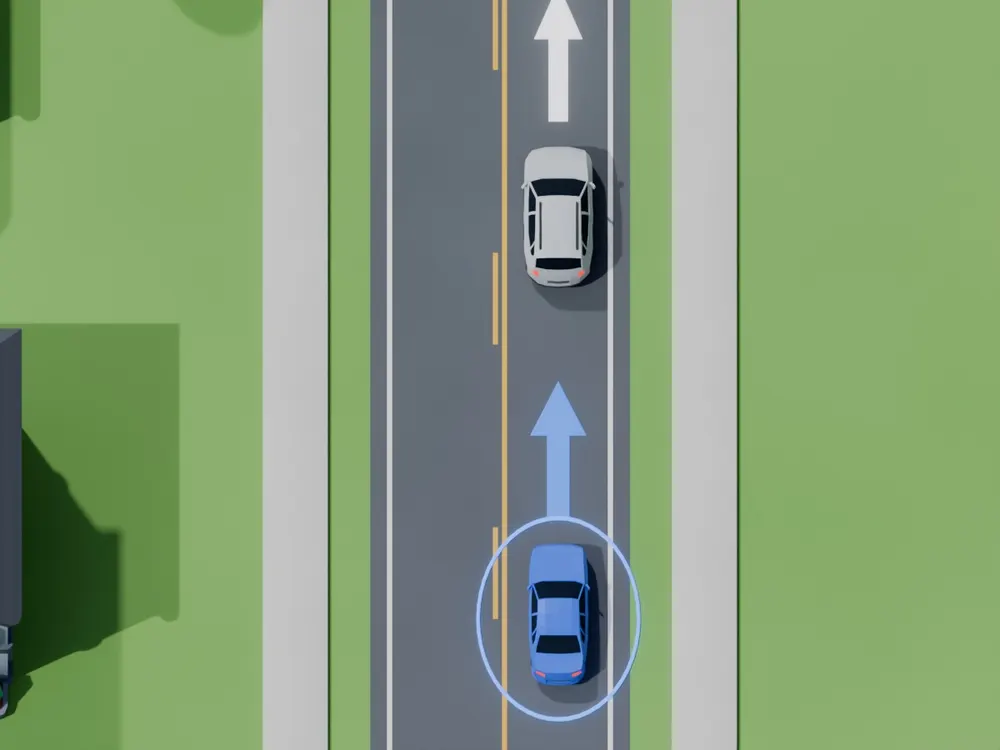
Correct answer: No, passing is not allowed from your side
The line closest to you is the one that applies. A solid yellow line on your side marks a no-passing zone for you.
-
A car in the lane next to you has stopped at a crosswalk. What should you do?
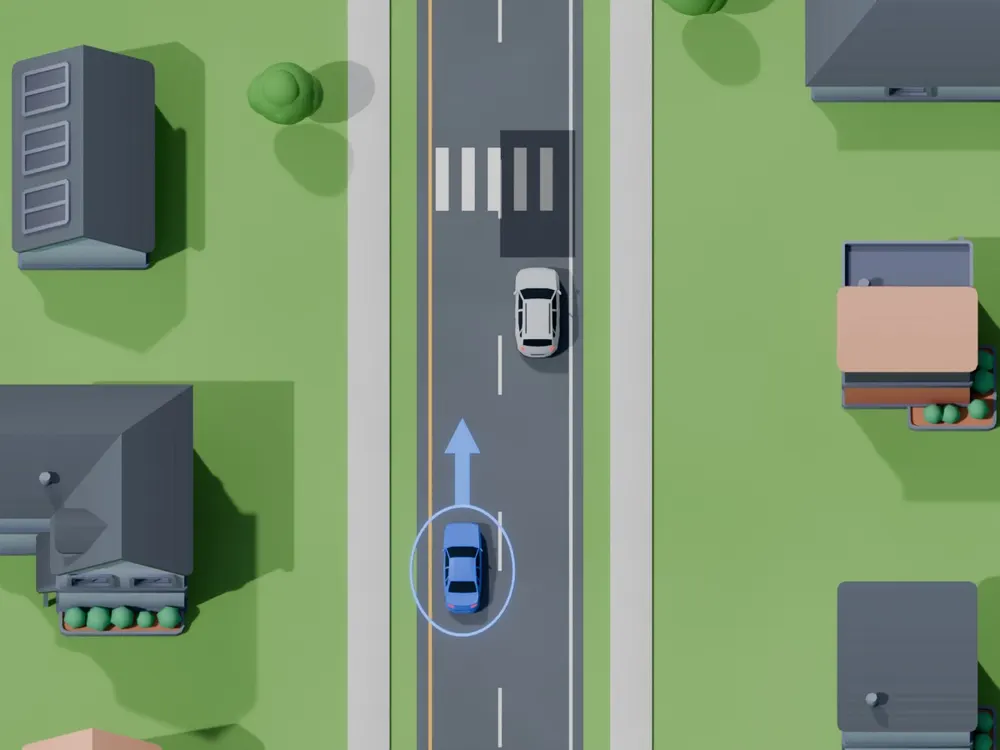
Correct answer: Slow down and be ready to stop; a pedestrian may be crossing out of view
The stopped car can hide a pedestrian from you. Never pass a vehicle that has stopped for someone in a crosswalk.
-
How close to the nearest rail of a railroad crossing is parking banned in Kansas?
Correct answer: Within 50 feet
Keep parked vehicles more than 50 feet from the nearest rail so trains and crossing traffic are not blocked or hidden.
Kansas Driving Handbook, p. 19 -
A properly marked Kansas school zone has no other speed posted. What is the maximum speed there?
Correct answer: 20 mph
When a school zone or business district is properly marked and no other limit is posted, the Kansas maximum is 20 mph.
Kansas Driving Handbook, p. 16 -
In which case are you NOT required to stop for a Kansas school bus with red lights flashing?
Correct answer: It is coming toward you across a median
Only a median or other physical barrier between the roadways lets oncoming traffic continue; painted lines, turn lanes and extra lanes do not.
Kansas Driving Handbook, p. 52 -
A Kansas driver refuses a chemical test for alcohol or drugs for the fourth time. How long is the mandatory suspension?
Correct answer: 10 years
Refusal suspensions grow with each case: 1 year, then 2, then 3, and 10 years for the fourth; a fifth failed test or refusal means permanent revocation.
Kansas Driving Handbook, p. 14 -
A diamond-shaped sign warns you about:
Correct answer: Road conditions or hazards ahead
Diamond-shaped signs are warning signs. They tell you about a curve, a crossing, a narrowing road or another condition ahead.
-
A Kansas child aged 4 to 8 may use a regular seat belt instead of a booster seat once the child weighs more than how much?
Correct answer: 80 pounds
Children aged 4 to 8 need a child seat or booster unless they weigh over 80 pounds or are taller than 4 feet 9 inches; from age 8 a seat belt is required.
Kansas Driving Handbook, p. 16
Your result
Finish the test to see your score. You need 20 of 25 correct.
Review your mistakes
About the Kansas DMV written test
Facts from the Kansas Department of Revenue, Division of Vehicles, with links to the official pages.
- Questions
- 25 multiple-choice questions source ↗
- To pass
- 80% to pass (20 of 25) source ↗
- Time limit
- Not timed; usually takes 15–20 minutes
- Permit age
- 14 years source ↗
- Fee
- $3 first exam; $10 learner's permit source ↗
- If you fail
- Retest the next working day for $1.50; after 4 fails, wait 6 months
- Test in Spanish
- Not stated by the state
- Online test
- Yes, online from a laptop or desktop computer source ↗
Our practice test: 25 questions, 20 correct to pass.
Official sources
What the Kansas test covers
Topics in our 418 Kansas practice questions, written from the Kansas Driving Handbook. 45 of them cover rules specific to Kansas.
- Intersections and turns37
- Regulatory signs33
- Sharing the road31
- Weather and night driving28
- Right of way26
- Pavement markings26
- Traffic signals25
- Lanes and passing22
- Parking21
- Warning signs20
Kansas numbers to know
The figures test writers love, from the Kansas Driving Handbook, Non-Commercial Driver’s Manual, AAMVA 09 Model Test Version. Open the handbook ↗
Speed limits
| Urban district, no sign | 30 mph |
| Marked school zone / business district | 20 mph |
| County or township road | 55 mph |
| State or federal highway | 65 mph |
| Designated separated multilane highway | 75 mph |
| Speeding in a work zone | Fines doubled |
Alcohol
| BAC limit: 21+ / under 21 | 0.08 / 0.02 |
| Test refusal: 1st / 2nd / 3rd / 4th | 1 / 2 / 3 / 10 years |
| First DUI | $750–$1,000; 48 h jail or 100 h service; interlock |
Permit and teen drivers
| Instruction permit from age | 14 |
| Restricted license from age | 15, permit held 1 year |
| Practice hours: at 15 / at 16 | 25 h / 50 h, 10 at night |
| Age 16: driving alone for any purpose | 5 a.m. – 9 p.m. |
| Minor non-sibling passengers: 15 / 16 | None / 1 |
Phones
| All drivers | No writing, sending or reading messages |
| Permit and restricted license holders | No wireless device (only to report a crime or get help) |
Seat belts and child seats
| Seat belt law | Primary: adults in front, children in any seat |
| Child seat / booster / seat belt | Under 4 / 4–8 (unless 80+ lb or 4'9"+) / 8+ |
School buses
| Bus on the other side of a median or barrier | No need to stop |
| Also stop for | Church and day care buses |
Points and penalties
| Suspension for moving violations | 3 in 12 months |
Distances
| No passing near a stopped emergency vehicle / intersection / tracks | 100 ft |
| Behind an emergency vehicle | 500 ft |
| Turn signal / U-turn visibility | 100 ft / 500 ft |
| No parking near a stop sign or signal / hydrant / tracks | 30 / 15 / 50 ft |
Questions and answers
How many questions are on the Kansas permit test?
25 multiple-choice questions. To pass: 80% to pass (20 of 25).
How many questions can you miss on the Kansas permit test?
You can miss up to 5 of 25 questions: you need 20 correct answers.
Can you take the Kansas permit test online?
Yes, online from a laptop or desktop computer.
What age can you get your permit in Kansas?
You can apply for a learner's permit at 14 years.
How long is the Kansas permit test?
Not timed; usually takes 15–20 minutes.
What happens if you fail the Kansas permit test?
Retest the next working day for $1.50; after 4 fails, wait 6 months.
How much does the Kansas permit test cost?
$3 first exam; $10 learner's permit.
How do I study for the Kansas permit test?
Read the Kansas Driving Handbook, then take practice tests in the real exam format until you pass them with room to spare. Learn the numbers by heart: speed limits, following distances, alcohol limits and permit rules. The dmvly app has 418 Kansas questions with an explanation for each one.