-
On a two-lane highway posted at 55 mph, you are lawfully passing a slower car going your way. How fast may you drive during the pass?
Correct answer: Up to 65 mph
On two-lane highways posted 55 mph or higher, Minnesota allows 10 mph above the limit, but only while you are completing a legal pass.
Minnesota Driver's Manual, p. 29 -
A car is approaching a stop sign on a side road as you near the intersection. What should you assume?
Correct answer: It might not stop, so be ready to slow or stop
Defensive drivers expect others to make mistakes. Look both ways even when cross traffic has a stop sign or red light.
-
Your freeway exit is a few miles ahead. What is the best way to prepare?
Correct answer: Know your exit and move into the proper lane early
Watch the exit signs and change lanes well in advance. The heavier the traffic, the earlier you should move.
-
You press the brake pedal and it sinks to the floor. What should you try first?
Correct answer: Pump the brake pedal quickly to build pressure
Pumping can restore some pressure in the brake system. If it does not work, move on to the parking brake and lower gears.
-
Which sign is the only one with an eight-sided (octagon) shape?
Correct answer: STOP
The octagon is reserved for STOP signs, so drivers can recognize them by shape alone, even from behind or in snow.
-
You feel dizzy, sleepy and get a headache while driving with the windows closed. What could be the cause?
Correct answer: Carbon monoxide from a leaking exhaust
Carbon monoxide has no smell and can kill. Get fresh air, have the exhaust checked, and never run the engine in a closed garage.
-
A driver holds the left arm out with the forearm pointing up. What does this mean?
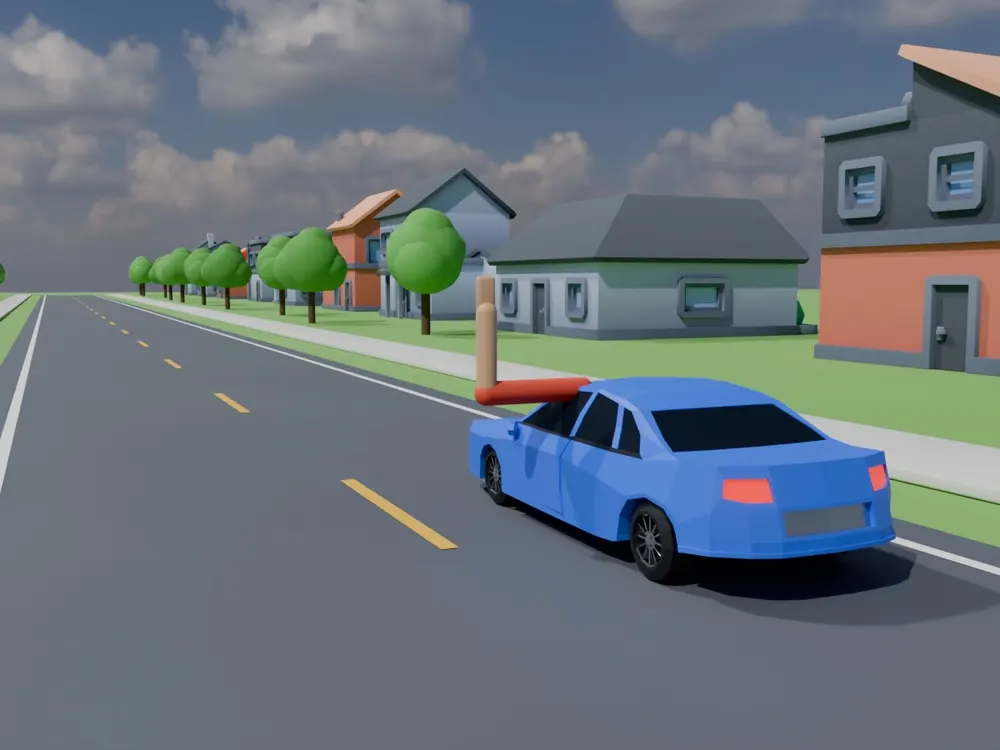
Correct answer: Right turn
Arm out and bent upward at the elbow is the hand signal for a right turn.
-
At a T intersection with no signs, you are on the road that ends. Who has the right-of-way?
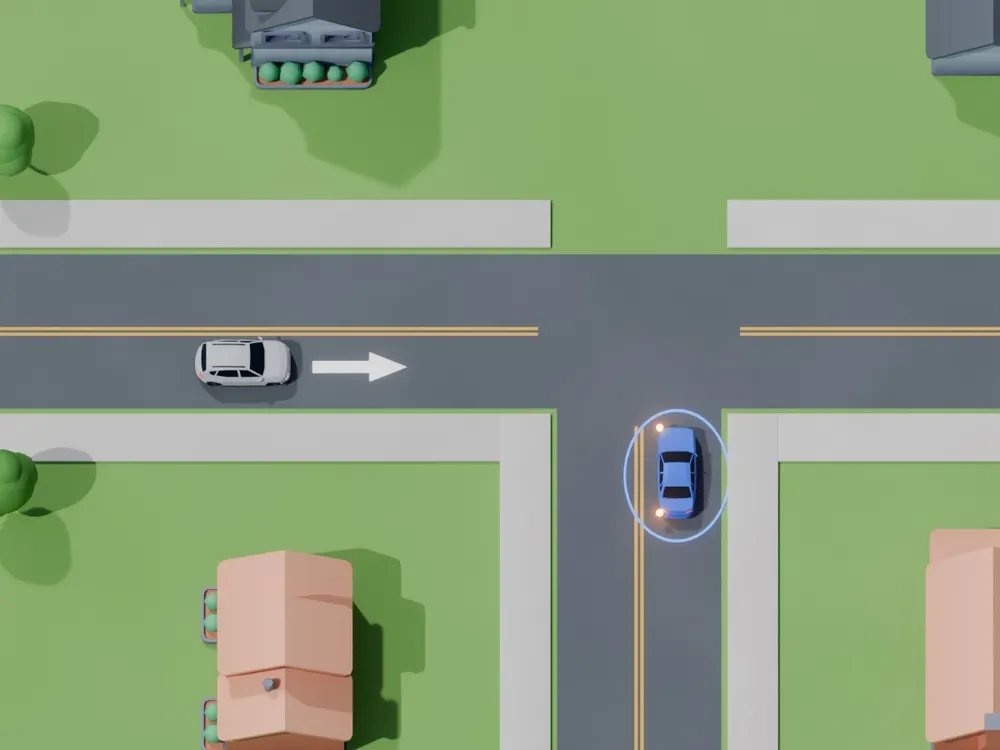
Correct answer: Traffic on the through road
At a T intersection without signs, vehicles on the road that continues straight go first. The driver on the ending road waits.
-
On a two-lane road you notice a broken yellow line just to your left. What does it tell you?
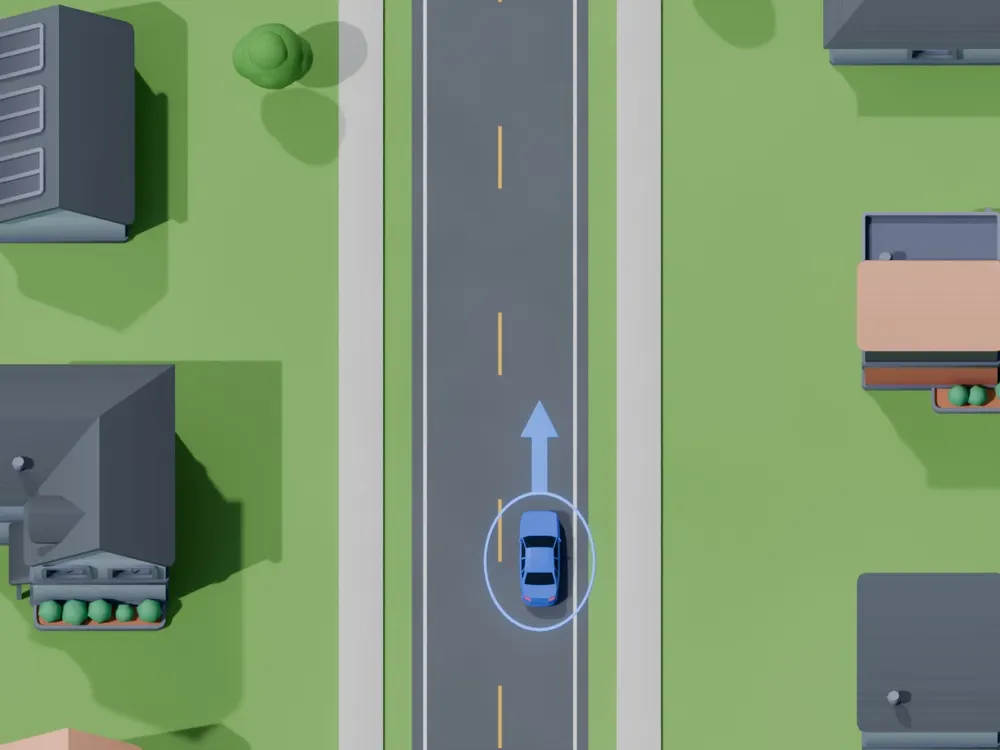
Correct answer: Traffic on the other side of the line is coming toward you
On a two-lane road the yellow center line separates opposite directions. Keep to the right of it.
-
You are stopping at a STOP sign. There is a marked crosswalk but no limit (stop) line. Where should your vehicle stop?
Correct answer: Before entering the crosswalk
With no limit line, the crosswalk marks where you stop. Stopping on it would block people crossing.
-
What is the safest way to drive after seeing this sign?
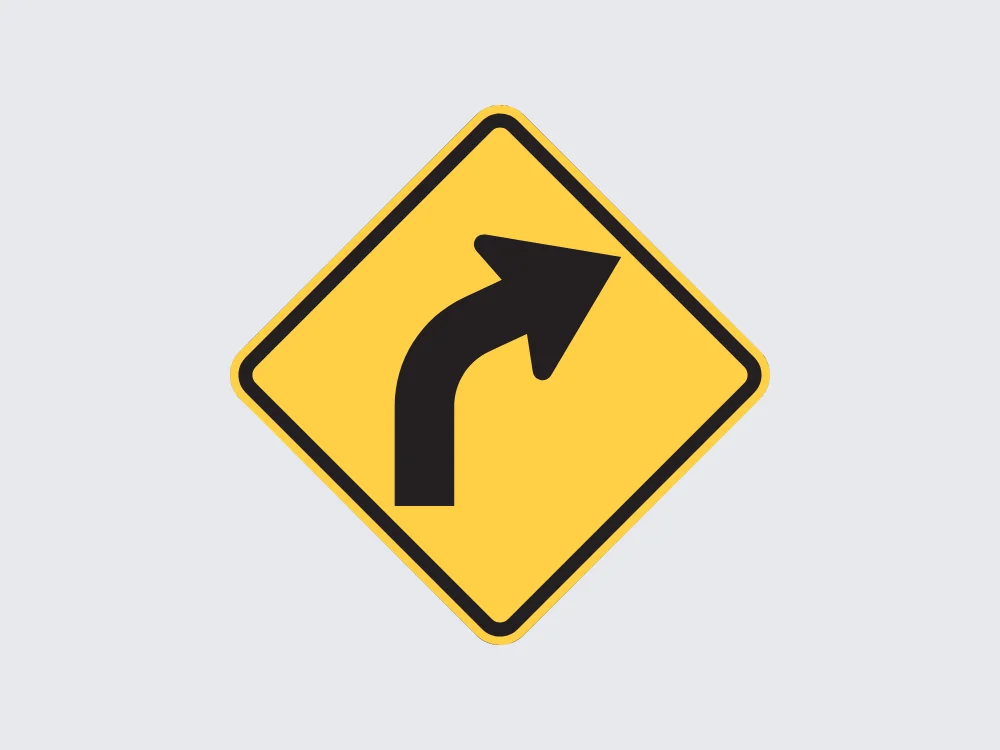
Correct answer: Slow down before the curve, keep right and do not pass
The sign shows the road curving in the direction of the arrow. Slow down before entering it, stay in your lane on the right, and do not pass.
-
Your car starts to skid on an icy road. What should you do with your feet?
Correct answer: Slowly take your foot off the gas and avoid slamming the brakes
Hard braking makes a skid worse. Easing off the gas lets the tires regain grip while you steer.
-
A Minnesota driver is convicted of driving faster than 100 mph. What happens to the driver's license?
Correct answer: Revoked for at least six months
Going over 100 mph costs you your driving privileges for a minimum of six months, on top of any fine.
Minnesota Driver's Manual, p. 30 -
Before driving after a snowstorm, what should you clear from your vehicle?
Correct answer: All windows, mirrors, lights, and the hood and roof
You need to see in every direction and be seen. Snow left on the roof or hood can slide onto the windshield or blow into other cars.
-
Traffic is backed up just past a railroad crossing. When may you start across the tracks?
Correct answer: Only when there is room for your whole vehicle on the other side
Never stop on the tracks. If traffic ahead could leave you stuck there, wait before the crossing.
-
At a J-turn on a four-lane divided highway, how do you head left from the side street?
Correct answer: Turn right, then U-turn at the median opening
At a J-turn, side-street drivers always turn right first, move into the left-turn lane, and make a U-turn at the median opening, yielding to oncoming traffic.
Minnesota Driver's Manual, p. 35 -
There is a crosswalk at an intersection. How close to it may you park in Minnesota?
Correct answer: No closer than 20 feet
Keep at least 20 feet between your parked car and an intersection crosswalk, and at least 30 feet from a roadside stop sign, flashing light or traffic signal.
Minnesota Driver's Manual, p. 38 -
A child has outgrown the forward-facing car seat. Until when must the child use a booster seat with a seat belt?
Correct answer: Until age 9 or the booster limit
Children 4 to 9 who are too big for the car seat use a booster with the belt. At 9, or once past the booster's size limit, the seat belt alone is used.
Minnesota Driver's Manual, p. 41 -
Besides emergency vehicles, which stopped vehicle with its warning lights on also triggers the Move Over rule in Minnesota?
Correct answer: A garbage or recycling truck
The same rule covers stalled cars and parked work vehicles with warning lights, such as road maintenance, utility, construction, postal, and garbage or recycling trucks.
Minnesota Driver's Manual, p. 47 -
A 17-year-old with a provisional license wants to make a call through the car's hands-free system while driving. Is that legal in Minnesota?
Correct answer: No; only a 911 emergency call
Permit and provisional drivers under 18 may not use a cell phone in any way, even hands-free; the only exception is dialing 911 for an emergency.
Minnesota Driver's Manual, p. 82 -
When should you use hand-and-arm signals instead of your turn signals?
Correct answer: When your signal lights are not working or are hard to see
Hand signals are a legal backup. Use them if your signal lights fail or bright sunlight makes them hard to see.
-
A driver tests at 0.05, and the officer can show the alcohol led to the driver's errors. What does Minnesota law allow?
Correct answer: A DWI arrest, despite the level
If alcohol clearly caused driving errors, Minnesota can arrest for DWI at levels as low as 0.04, not only at 0.08.
Minnesota Driver's Manual, p. 96 -
A pedestrian is in the crosswalk at the exit of a roundabout you are leaving. What should you do?
Correct answer: Yield to the pedestrian before exiting
Roundabout entries and exits often have crosswalks. Drivers must yield to pedestrians in them both when entering and when leaving.
-
A 16-year-old with an instruction permit wants to practice driving. Who must sit in the front passenger seat?
Correct answer: A licensed driver aged 21 or older
Permit holders under 18 need a licensed supervisor aged 21 or older; those 18 and older need one aged at least 18.
Minnesota Driver's Manual, p. 16 -
You are waiting to turn left and an oncoming motorcycle is approaching. What is a common mistake to avoid?
Correct answer: Turning in front of it because it seemed far away or slow
Many serious motorcycle crashes happen when a car turns left across the rider's path. Judge carefully and wait if unsure.
-
A 15-year-old with no license is convicted of an alcohol violation committed while driving. Under Vanessa's Law, when can the teen first get a permit or license?
Correct answer: Not until turning 18
Vanessa's Law bars unlicensed teens convicted of crash-related or alcohol and drug violations from any permit or license until age 18.
Minnesota Driver's Manual, p. 18 -
You park on a hill where there is no curb. Which way should you turn your front wheels, uphill or downhill?
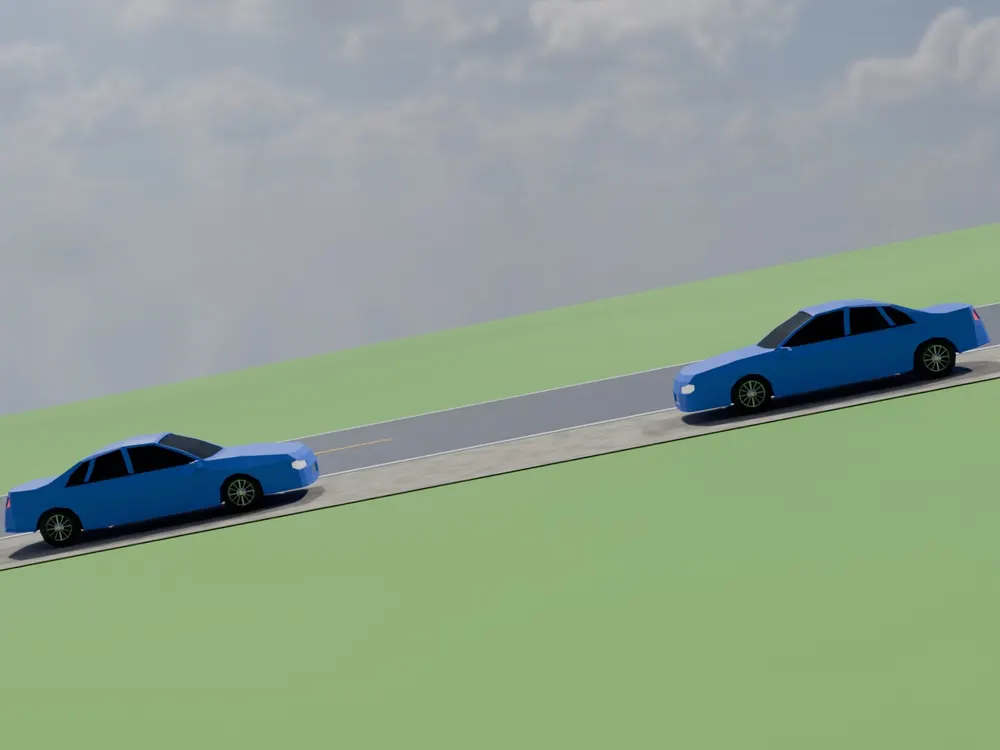
Correct answer: Toward the edge of the road, so the car would roll away from traffic
Without a curb, turn the wheels toward the shoulder in both directions. If the brakes fail, the car rolls off the road instead of into traffic.
-
You are turning right on a green light. The pedestrian signal for the street you are turning onto shows a walking person. What should you expect?
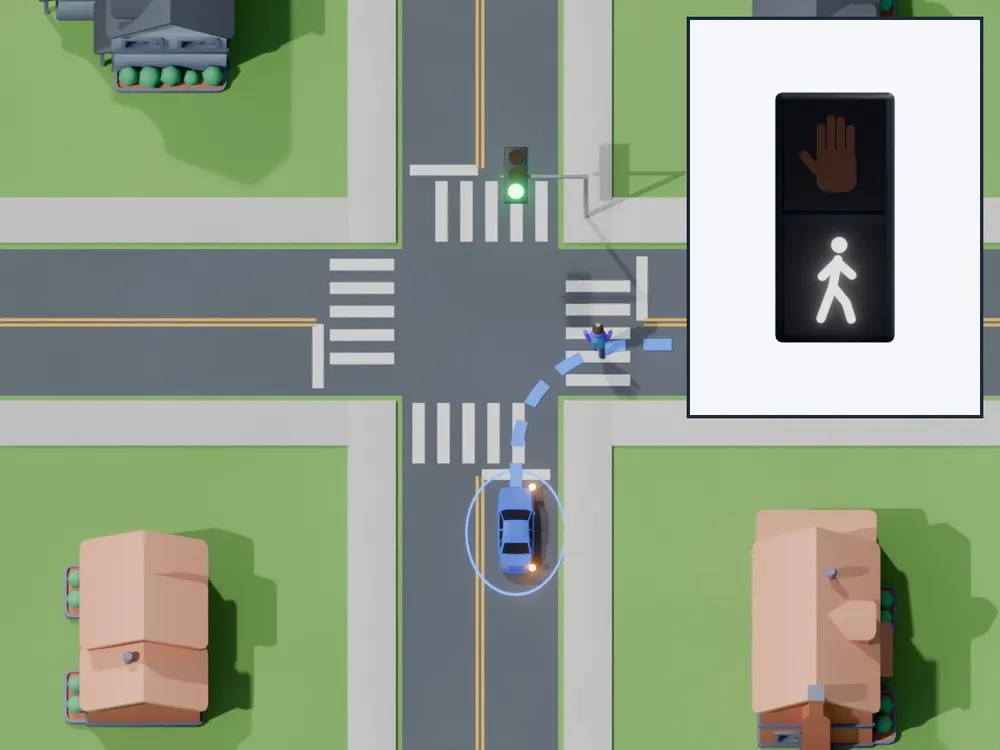
Correct answer: Pedestrians may be crossing in your path; yield to them
The walking person tells pedestrians they may cross. Turning drivers must check the crosswalk and yield.
-
You are on a divided roadway. A school bus with flashing red lights is stopped on the other side of the divider. What must you do?
Correct answer: Go on carefully; you need not stop
On a divided roadway, traffic on the far side of the divider from the bus does not have to stop, but stay alert for children.
Minnesota Driver's Manual, p. 45 -
What does this sign warn you about?
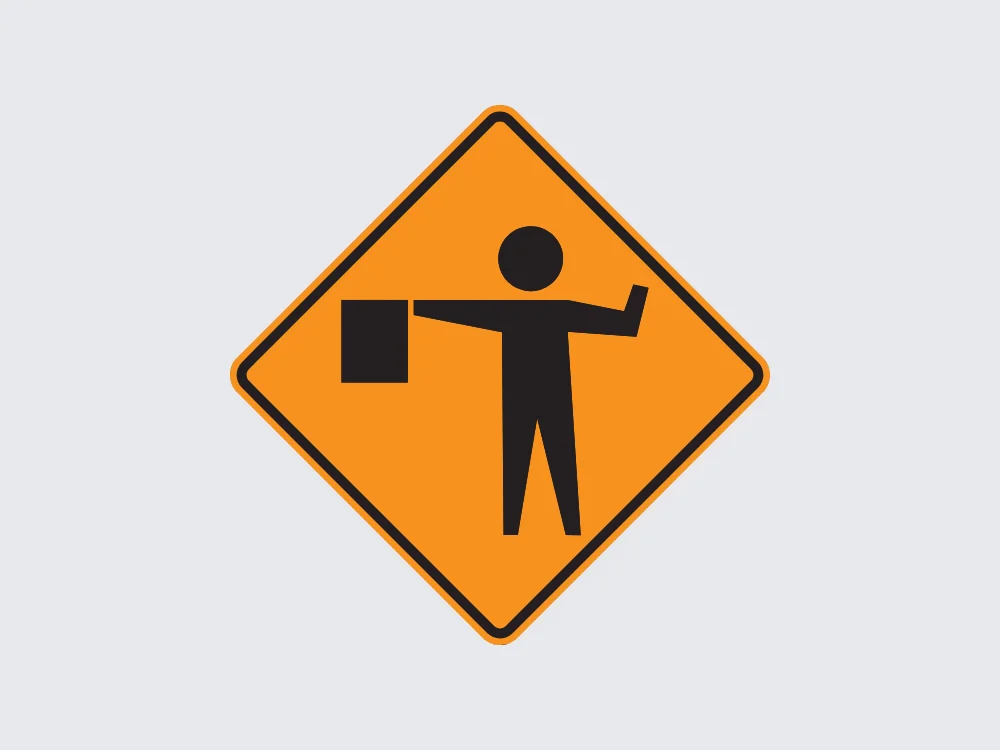
Correct answer: A worker with a flag or paddle is directing traffic ahead
This sign warns of a flagger ahead. Be ready to stop or slow down as the flagger directs.
-
A pedestrian is crossing at a street corner where no crosswalk lines are painted. What should you do?
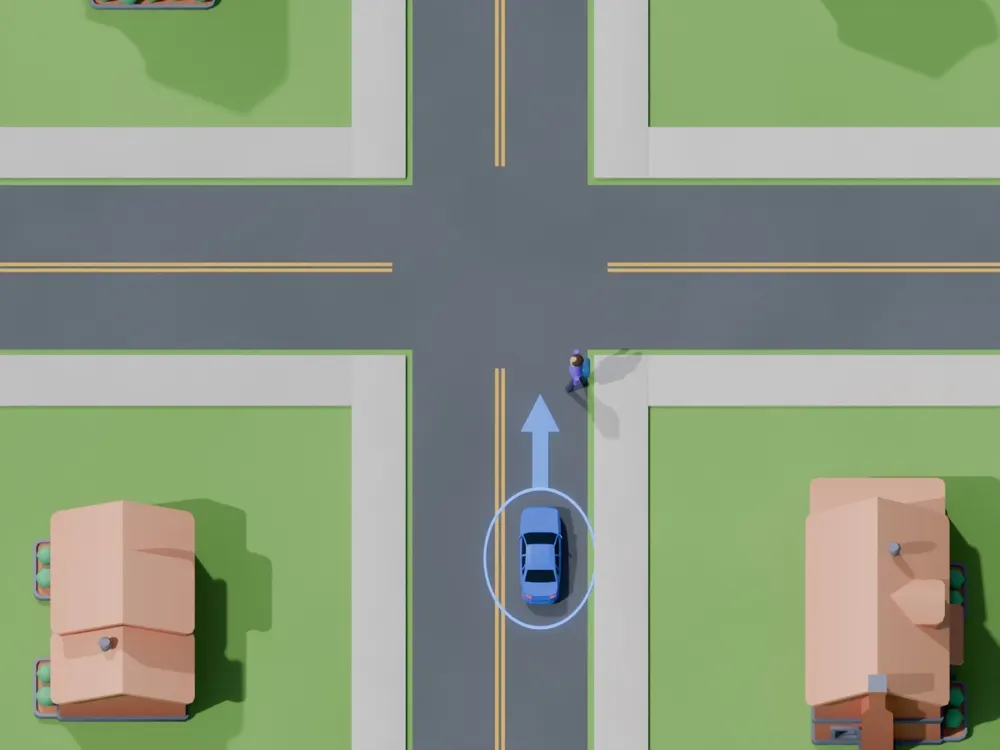
Correct answer: Yield, because an intersection can have an unmarked crosswalk
Not every crosswalk is painted. Pedestrians have the right-of-way in both marked and unmarked crosswalks.
-
Your test shows 0.08. Before your Minnesota license is revoked, what temporary license may you receive?
Correct answer: One valid for 7 days
A driver at 0.08 or above, or who refuses testing, may get a seven-day temporary license; the revocation starts when it ends.
Minnesota Driver's Manual, p. 97 -
Why is it dangerous to cut in front of a large truck and then slow down?
Correct answer: A truck needs much more distance to stop than a car
Heavy vehicles take longer to stop, especially when loaded. Taking away their safety space can lead to a rear-end crash.
-
You are passing on a two-lane road. Before you come within what distance of an oncoming vehicle must you be back on the right side?
Correct answer: 100 feet
Minnesota law says you must be back in your right-hand lane before the oncoming vehicle is 100 feet away.
Minnesota Driver's Manual, p. 37 -
A fire truck is on its way to an emergency. Unless you are on official emergency business, how close may you follow it?
Correct answer: Never within 500 feet
Only vehicles on official emergency duty may follow a fire truck that is answering a call more closely than 500 feet.
Minnesota Driver's Manual, p. 47 -
You find yourself driving alongside another car in its blind spot. What should you do?
Correct answer: Either pass it or drop back so the driver can see you
If you stay in another driver's blind spot, they may change lanes into you. Move through it or fall back.
-
A freeway on-ramp has a ramp meter showing green. How many vehicles may enter on that one green light?
Correct answer: One
Ramp meters let drivers onto the freeway in turns: a single car goes per green, and driving through the red light is illegal.
Minnesota Driver's Manual, p. 77 -
A Minnesota driver must use an ignition interlock device. At what alcohol level will it keep the engine from starting?
Correct answer: 0.02 or higher
The driver blows into the device before starting, and a reading of 0.02 or more blocks the start.
Minnesota Driver's Manual, p. 98 -
What does the 'basic speed law' require?
Correct answer: Never driving faster than is safe for current conditions
Whatever the sign says, your speed must be safe for the traffic, road and weather around you.
-
Signals at an intersection are flashing red in every direction. How do you handle it?
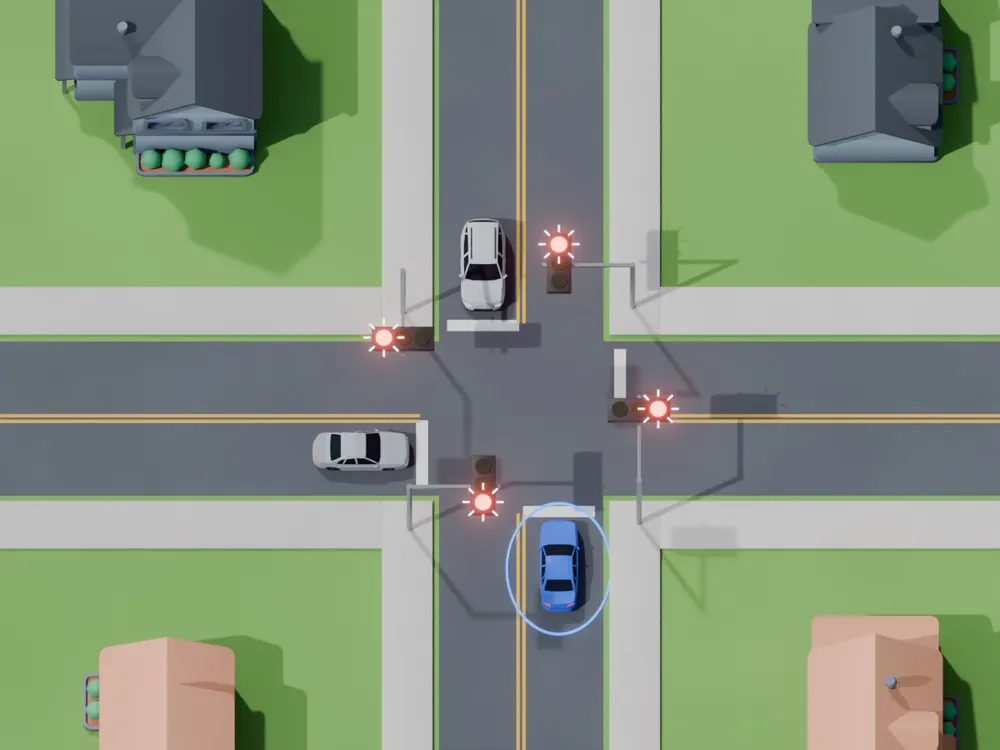
Correct answer: As an all-way stop: stop, then take turns following right-of-way rules
Flashing red means stop, just like a STOP sign. When it flashes for everyone, the intersection works like an all-way stop.
Your result
Finish the test to see your score. You need 32 of 40 correct.
Review your mistakes
About the Minnesota DVS written test
Facts from the Minnesota Department of Public Safety, Driver and Vehicle Services, with links to the official pages.
- Questions
- Not published by the state; our practice test uses 40 questions
- To pass
- 80% to pass source ↗
- Time limit
- No time limit at a DVS exam station; 40 minutes with a proctor
- Permit age
- 15 years source ↗
- Fee
- $29.50 instruction permit; first two tests free, then $10 source ↗
- If you fail
- One test per day; $10 for each try after two fails
- Test in Spanish
- Yes, the test is offered in Spanish source ↗
- Online test
- No test from home; at a DVS station or an approved proctor source ↗
Our practice test: 40 questions, 32 correct to pass.
Official sources
What the Minnesota test covers
Topics in our 431 Minnesota practice questions, written from the Minnesota Driver's Manual. 59 of them cover rules specific to Minnesota.
- Intersections and turns39
- Sharing the road33
- Regulatory signs33
- Weather and night driving29
- Right of way26
- Pavement markings26
- Traffic signals25
- Lanes and passing24
- Parking22
- Warning signs20
Minnesota numbers to know
The figures test writers love, from the Minnesota Driver's Manual. Open the handbook ↗
Speed limits
| Other roads, no sign | 55 mph |
| Urban or town road | 30 mph |
| Alley | 10 mph |
| Passing on a two-lane highway posted 55+ | Limit + 10 mph |
Alcohol
| DWI: passenger car / commercial vehicle | 0.08 / 0.04 |
| Under 21: any detectable alcohol | Suspended 30 days (2nd: 180) |
| Refusing a test | Crime; revoked 1–6 years |
Permit and teen drivers
| Instruction permit from age | 15 (supervisor 21+) |
| Supervised driving log | 50 h, 15 at night (40 h with parent class) |
| Provisional, first 6 months: no driving | 12 a.m. – 5 a.m. |
| Passengers under 20: first 6 months / next 6 | 1 / up to 3 (family exempt) |
Phones
| Permit or provisional, under 18 | No phone, even hands-free (911 only) |
| Texting, email, internet | Banned, even stopped in traffic |
Seat belts and child seats
| Seat belts | Every seat; can be stopped for belts alone |
| Back seat required | Under 13, if available |
| Booster seat | Ages 4–9 |
School buses
| Bus with flashing red lights | Stop at least 20 ft away |
| Failing to stop for a school bus | Fine of $500+, loss of license |
Points and penalties
| Driving over 100 mph | Revoked 6+ months |
| Speeding in a work zone | Extra $300 fine |
Distances
| Following distance | 3 s (4–5 s in poor conditions) |
| Low beams: oncoming / following | 1,000 ft / 200 ft |
| Railroad crossing with signals active | Stop 10+ ft from rail or gate |
| Passing a bicyclist | At least 3 ft |
| No parking near: hydrant / crosswalk / railroad | 10 / 20 / 50 ft |
Questions and answers
How many questions are on the Minnesota permit test?
Not published by the state; our practice test uses 40 questions. To pass: 80% to pass. The DVS does not publish the exact number, so our practice test uses a typical format.
Can you take the Minnesota permit test in Spanish?
Yes, the test is offered in Spanish.
Can you take the Minnesota permit test online?
No test from home; at a DVS station or an approved proctor.
What age can you get your permit in Minnesota?
You can apply for a learner's permit at 15 years.
How long is the Minnesota permit test?
No time limit at a DVS exam station; 40 minutes with a proctor.
What happens if you fail the Minnesota permit test?
One test per day; $10 for each try after two fails.
How much does the Minnesota permit test cost?
$29.50 instruction permit; first two tests free, then $10.
How do I study for the Minnesota permit test?
Read the Minnesota Driver's Manual, then take practice tests in the real exam format until you pass them with room to spare. Learn the numbers by heart: speed limits, following distances, alcohol limits and permit rules. The dmvly app has 431 Minnesota questions with an explanation for each one.