-
A Vermont officer stops you and you have no insurance on the vehicle. Besides a fine, what do you get?
Correct answer: 2 points on your record
Driving with no insurance brings a ticket, a fine and 2 points. If you have insurance but no card with you, you get 15 days to show it.
Vermont Driver's License Manual (VN-007), p. 68 -
You have parked on a busy street. What should you do before opening your door?
Correct answer: Check for passing cars, bicycles, and motorcycles
An opened door can hit a cyclist or a passing vehicle. Look carefully and get out only when it is clear.
-
You see smoke coming from under the hood. What should you do?
Correct answer: Pull off the road, turn off the engine, get everyone away, and call for help
A vehicle fire can spread quickly. Your safety matters more than the car, so move away and let firefighters handle it.
-
When you park on a two-lane Vermont road, how close to the right curb or road edge must your right wheels be?
Correct answer: Within 12 inches
Park facing the same way as traffic with your right wheels no more than 12 inches from the curb or edge.
Vermont Driver's License Manual (VN-007), p. 30 -
You come up behind a town snowplow working on the road with its lights flashing. What does Vermont law require?
Correct answer: Proceed carefully and let it have the right-of-way
State, city and town maintenance vehicles working on the highway, such as plows, must be given the right-of-way, and you must proceed with care around them.
Vermont Driver's License Manual (VN-007), p. 32 -
What are the minimum liability insurance amounts in Vermont?
Correct answer: $25,000 / $50,000 / $10,000
You need at least $25,000 of coverage for injury or death of one person, $50,000 for two or more, and $10,000 for property damage.
Vermont Driver's License Manual (VN-007), p. 68 -
Orange signs and cones are on the road ahead. Which driving habit fits best?
Correct answer: Leave extra space and expect sudden slowing or stopping
Traffic in work zones can stop without warning. A larger gap and full attention help you avoid rear-end crashes.
-
When turning left, which oncoming vehicles must you wait for?
Correct answer: Any that are close enough to be a hazard
The rule is to yield to oncoming traffic near enough to create a danger. If you are unsure, let it pass before turning.
-
A Vermont junior driver is convicted of a single 3-point speeding violation. What happens to the license?
Correct answer: It is recalled for 90 days
A junior operator loses the license for 90 days after one 3-point speeding ticket or after reaching 6 points in total.
Vermont Driver's License Manual (VN-007), p. 22 -
A truck is backing across the road into a loading area. What should you do?
Correct answer: Stop and wait until it finishes
Passing behind a backing truck puts you in its rear blind spot where the driver cannot see you.
-
An oncoming vehicle's headlights are very bright. Where should you look?
Correct answer: Toward the right edge of your lane
Looking at the right edge keeps you in your lane without being blinded, while you watch the other car from the corner of your eye.
-
Who in a moving vehicle must be buckled up under Vermont law?
Correct answer: Every person in the vehicle
Every occupant must wear a safety belt or be in an approved child restraint.
Vermont Driver's License Manual (VN-007), p. 63 -
The car ahead is turning left and there is no room on the pavement to its right. May you drive onto the unpaved edge to pass it?
Correct answer: No, never leave the pavement to pass
Passing by driving off the paved part of the road is not allowed. Wait until the car ahead completes its turn.
-
What is the fine for a first violation of Vermont's portable electronic device law?
Correct answer: $100 to $200
A first offense costs $100–$200. A second or later offense costs $250–$500.
Vermont Driver's License Manual (VN-007), p. 56 -
What does this sign mean?
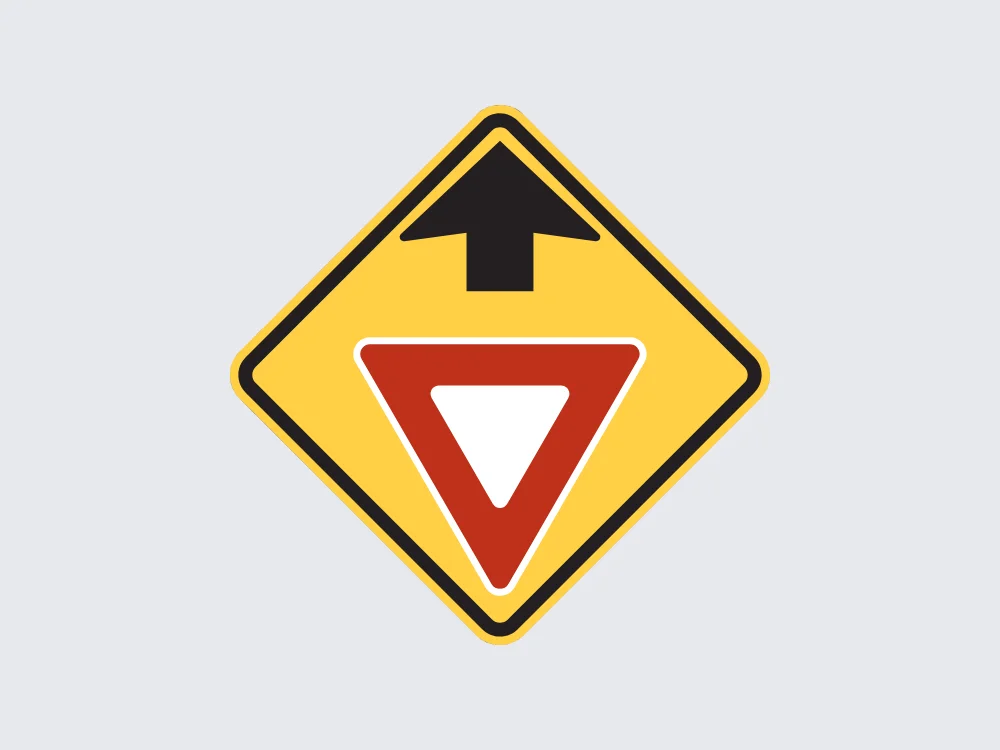
Correct answer: A YIELD sign is ahead; slow down and be ready to yield
It warns of a YIELD sign ahead, so be ready to slow down or stop to let other traffic go first.
-
A Vermont driver under 21 can get a civil traffic violation starting at what alcohol concentration?
Correct answer: 0.02
For drivers under 21 the threshold is 0.02. The license is suspended, and the driver pays for an alcohol and driving education program.
Vermont Driver's License Manual (VN-007), p. 53 -
What does this sign tell you?
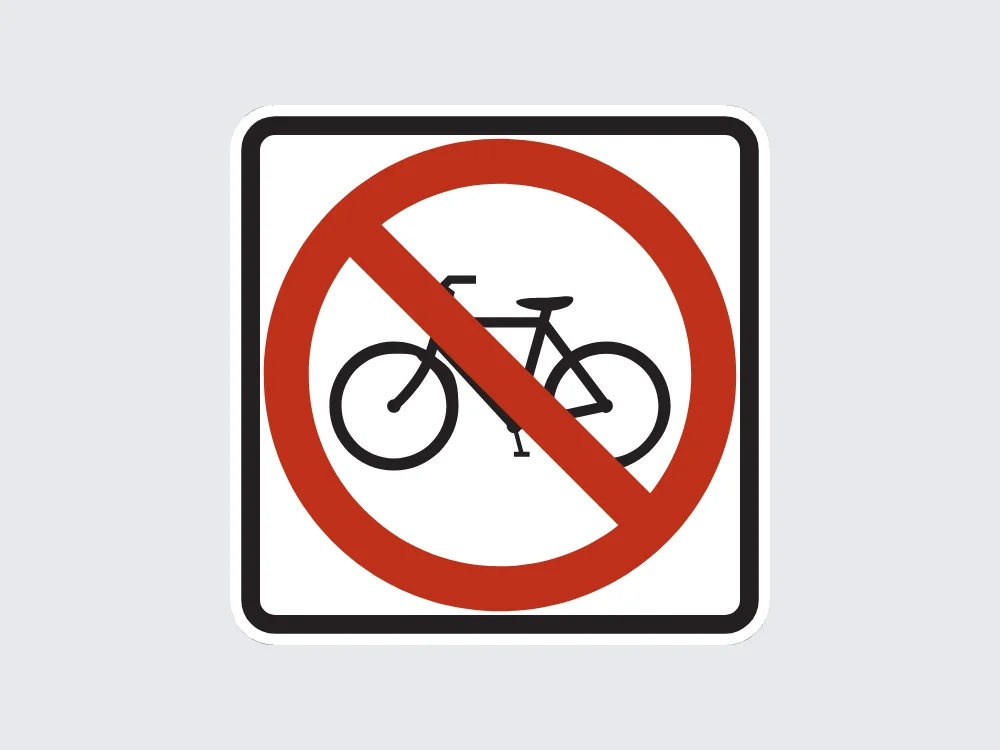
Correct answer: Bicycles are not allowed on this road
A bicycle inside a red circle with a slash prohibits bicycles. A warning about bicyclists would be a yellow diamond instead.
-
A traffic light is flashing red. What should you do?
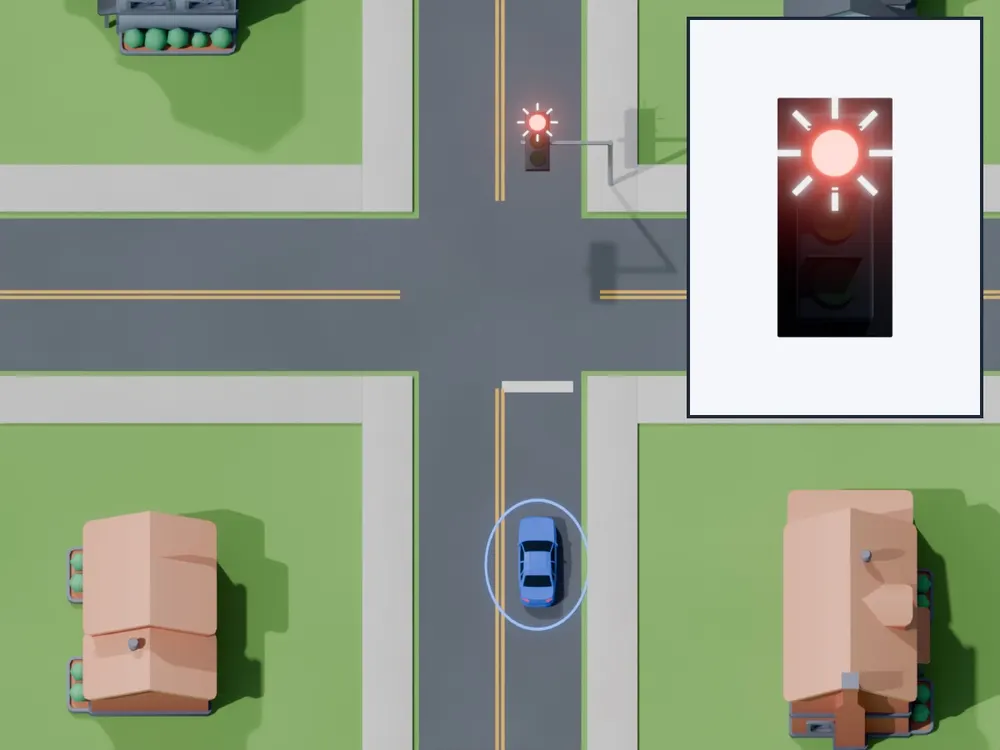
Correct answer: Treat it like a STOP sign: stop, then go when it is safe
A flashing red light has the same meaning as a STOP sign. Make a full stop, yield as needed, and go when the way is clear.
-
Which lane should you end up in after a right turn?
Correct answer: The right lane of the street you enter
Finish a right turn in the nearest right lane without swinging wide. Change lanes later only after signaling and checking.
-
You are about to turn right and a bike lane marked with a solid white line runs along the curb. What should you do?
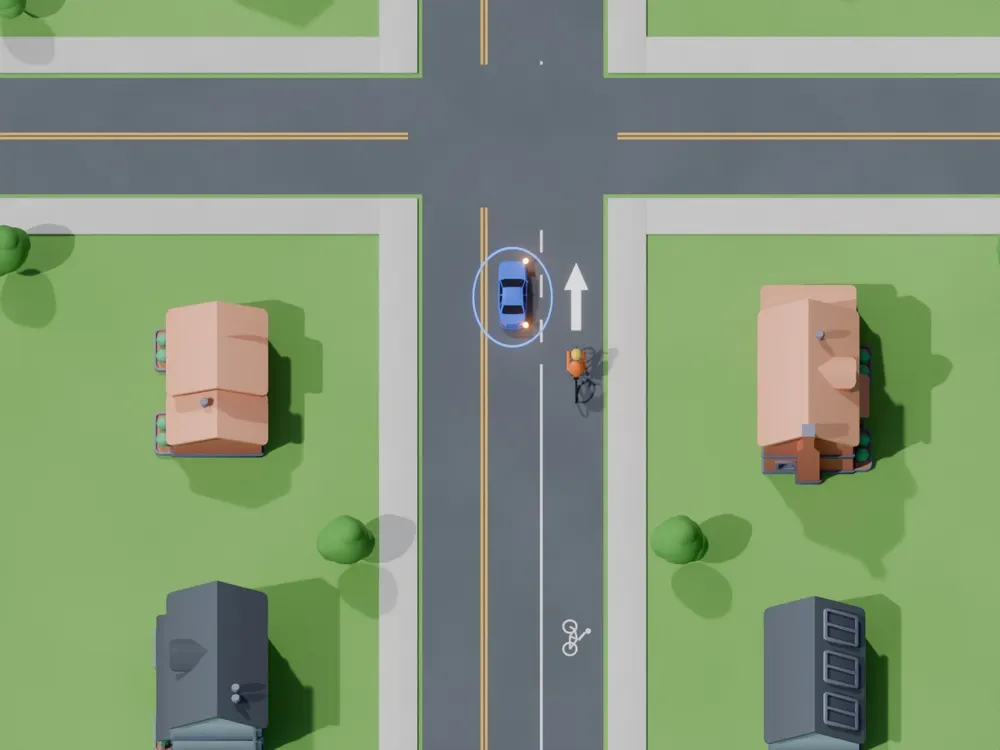
Correct answer: Check for bicyclists and yield before crossing into the bike lane to turn
Bike lanes are for bicyclists. Drivers may cross or briefly use them to turn, but only after checking blind spots and yielding to bicyclists.
Your result
Finish the test to see your score. You need 16 of 20 correct.
Review your mistakes
About the Vermont DMV written test
Facts from the Vermont Department of Motor Vehicles, with links to the official pages.
- Questions
- 20 questions source ↗
- To pass
- 16 correct answers out of 20 source ↗
- Answer choices
- 4
- Time limit
- No published time limit
- Permit age
- 15 years source ↗
- Fee
- $39 per test attempt; $24 learner's permit source ↗
- If you fail
- Wait at least one day; unlimited attempts, each paid
- Test in Spanish
- Yes, the online test is offered in Spanish source ↗
- Online test
- Yes, online only; no longer taken at DMV offices source ↗
Our practice test: 20 questions, 16 correct to pass.
Official sources
What the Vermont test covers
Topics in our 433 Vermont practice questions, written from the Vermont Driver's License Manual (VN-007). 60 of them cover rules specific to Vermont.
- Intersections and turns37
- Regulatory signs33
- Weather and night driving30
- Sharing the road30
- Right of way26
- Pavement markings26
- Traffic signals25
- Parking22
- Lanes and passing21
- Emergencies21
Vermont numbers to know
The figures test writers love, from the Vermont Driver's License Manual (VN-007). Open the handbook ↗
Speed limits
| Any road, no sign / Interstate | 50 mph / 65 mph |
| Speeding in a work zone | Fine doubled |
| Passing a stopped emergency or repair vehicle | Change lanes, or 20 mph under the limit |
Alcohol
| Alcohol: 21 and older / under 21 | 0.08 / 0.02 |
| Refusing a test (Implied Consent) | License lost for at least 6 months |
Permit and teen drivers
| Permit supervisor (front seat) | Parent/guardian, instructor, or licensed 25+ |
| Permit before junior license | At least 1 year |
| Supervised practice | 40 hours, 10 at night |
| Junior license: passengers | Months 1–3 only with a supervisor, 4–6 family, then up to the number of belts |
| Junior: one 3-point speeding ticket or 6 points | 90-day recall |
Phones
| Handheld device while driving | Banned, even when stopped |
| Phone fine: first / repeat | $100–$200 / $250–$500 |
| Junior driver texting | 30-day recall |
Seat belts and child seats
| Seat belts | Everyone in the vehicle |
| Child seats | Under 2 rear-facing; 2–4 harness; under 8 booster |
| Back seat (if practical) | Under 13 |
School buses
| School bus with red lights: no stop needed | Concrete barrier, or oncoming on a divided highway |
| Passing a stopped school bus | 5 points |
Points and penalties
| Suspension notice | 10 points |
| Not yielding: pedestrian / emergency vehicle | 4 / 5 points |
Distances
| Turn signal before turning | At least 100 ft |
| Following distance | 4 seconds or more |
| No parking near hydrant / crosswalk / rail | 6 ft / 20 ft / 50 ft |
| Stopping for a train | At least 15 ft from the nearest rail |
| Passing a bicyclist | At least 4 ft |
Questions and answers
How many questions are on the Vermont permit test?
20 questions. To pass: 16 correct answers out of 20.
How many questions can you miss on the Vermont permit test?
You can miss up to 4 of 20 questions: you need 16 correct answers.
Can you take the Vermont permit test in Spanish?
Yes, the online test is offered in Spanish.
Can you take the Vermont permit test online?
Yes, online only; no longer taken at DMV offices.
What age can you get your permit in Vermont?
You can apply for a learner's permit at 15 years.
How long is the Vermont permit test?
No published time limit.
What happens if you fail the Vermont permit test?
Wait at least one day; unlimited attempts, each paid.
How much does the Vermont permit test cost?
$39 per test attempt; $24 learner's permit.
How do I study for the Vermont permit test?
Read the Vermont Driver's License Manual (VN-007), then take practice tests in the real exam format until you pass them with room to spare. Learn the numbers by heart: speed limits, following distances, alcohol limits and permit rules. The dmvly app has 433 Vermont questions with an explanation for each one.